
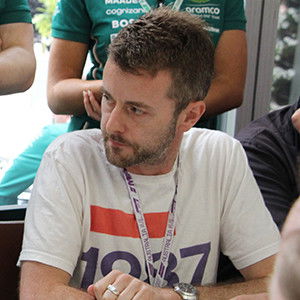

Speaking to Aston Martin’s website ahead of the British Grand Prix, Newey admitted the Silverstone-based squad had been on the back foot from the beginning of Formula 1’s new rules era.
“Extremely challenging,” Newey said of Aston Martin’s season so far.
“On both the chassis side and the power unit side, we’ve been on the back foot from the start. In hindsight, we probably put too much expectation on ourselves – and of course, you must never forget the quality of the opposition you’re up against across the grid.
“We didn’t start serious work on the ’26 car until mid-March 2025 and didn’t get a model into the wind tunnel until mid-April.
“That left us several months behind our rivals – and that’s a huge gap to close.”
Aston Martin entered 2026 with high expectations after Newey’s arrival and the start of its works partnership with Honda, but its campaign has been hampered by limited running, power unit issues, excess weight and aerodynamic problems.
Click here to find out how.
Newey said the scale of the task became clear at the season-opening Australian Grand Prix, where Aston Martin had its first meaningful running after a disrupted pre-season.
“Melbourne was the wake-up call,” he said.
“Because of various power unit challenges, our first proper running was actually Free Practice Three at the Australian Grand Prix.
“Before that, in Barcelona and at the two Bahrain tests, we spent too much time in the garage just trying to get the power unit to run correctly with the chassis and gearbox.”
Newey also admitted the AMR26 had been compromised by the speed of its development, with weight one of the major issues.

“On the chassis side, we’re quite a long way overweight,” he said.
“Some of that comes from integrating the power unit and dealing with vibration issues we’ve had to work through with Honda, but we also didn’t do as good a job as we should have on our side at saving weight.
“When you design in a rush, weight is the first thing that suffers because you don’t have the time to thoroughly optimise everything.”
Newey explained that Aston Martin had resisted bringing smaller updates race by race, and was instead focused on a larger package that he confirmed would arrive at the Hungarian Grand Prix.
“We plan to introduce our upgrade in Hungary on both cars,” he said.
“The main structural elements remain the same – the chassis and gearbox architecture don’t fundamentally change – but we’ve taken weight out of both, which required re-homologating and crash testing the forward chassis.
“The front suspension is unchanged. The rear suspension is slightly revised. We’ve developed a new nose and substantially revised aerodynamic surfaces.
“So, while the core structure is similar, it’s a big aerodynamic package coupled with significant weight reduction. The target is to get very close to the weight limit.”
Newey added Aston Martin is expecting a significant gain, though he stopped short of putting a number on the improvement.
“We’re predicting a large step, but I’m reluctant to put specific numbers out there. We’ll have to see when the car gets on track,” he said.
The update could also prove important for Fernando Alonso, whose future beyond 2026 remains uncertain.
Newey said the two-time world champion wants to see evidence Aston Martin is moving in the right direction before committing to another season.
“It’s very important,” Newey said.
“Fernando is really looking forward to the upgrade and, if it performs we hope he’ll be in the cockpit for another season.
“Given his experience, his feel for the car, his ability to guide development, he’s a tremendous asset.
“But he wants to see clear, tangible progress.”
The 67-year-old also addressed his health after a “difficult period”, saying he is now in better shape after having to manage his workload.
“I’m OK now, but it’s been a difficult period. As I said earlier, it never rains but it pours.
“In truth, I was not 100 per cent last year. I had to balance health and work much more carefully.”





















Discussion about this post