


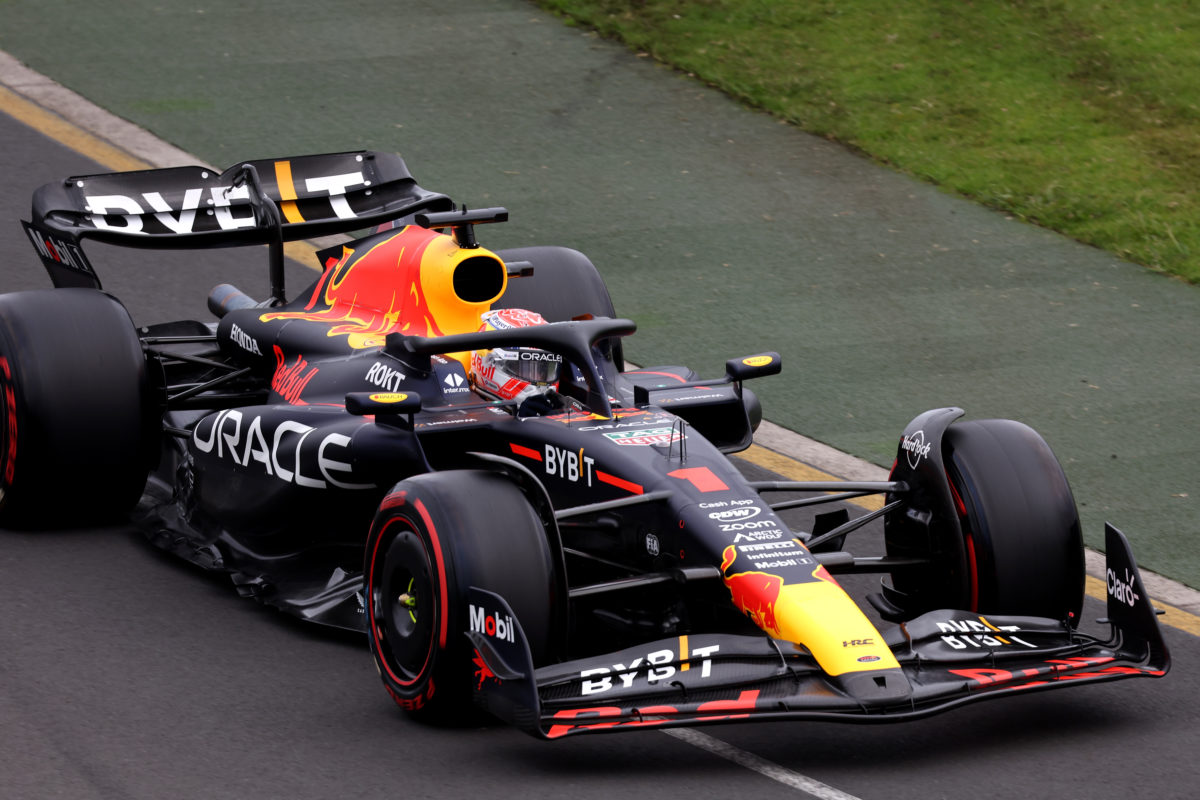
Christian Horner has reacted coyly to suggestions that Red Bull holds such a superior pace advantage it is effectively sandbagging to avoid being reined in by the FIA.
Mercedes driver George Russell has accused Red Bull of “holding back” and “being embarrassed to show their full potential”, believing the RB19 to be around seven-tenths of a second quicker than any other car in the field.
Mercedes team principal Toto Wolff has also declared the straight-line advantage of the Red Bull, particularly when the DRS is open, to be “mind-boggling” after seeing the ease with which Max Verstappen breezed past Lewis Hamilton to take the lead in the Australian Grand Prix.
What followed from Verstappen, however, was truly astonishing. After overtaking Hamilton around the outside of the W14 on the sweeping left-handed curve before Turn 9, the reigning F1 champion then opened up a two-second gap by the end of the lap, in the space of about two kilometres.
Verstappen then backed off but did all that was required of him in creating a comfortable 10-second cushion that he managed through to the chaotic end when the race was restarted twice in the final four laps.
When Russell’s comments were put to Horner, he initially replied: “That’s very generous of him. I mean, his team would know too well about those kinds of advantages.”
Pressed on whether the Briton’s claims were true, Horner was circumspect, adding: “There’s always an element of managing that goes on in any race.
“You could see, because it was a one-stop race and a very early one-stop race, of course, there was an element of tyre management that was going on, which is what they were doing.
“You could see Checo (Perez) wasn’t hanging about. He wasn’t cruising around, or holding back seven-tenths per lap.
“The grid was certainly a little bit closer at this venue.”
Red Bull qualifying pace different to race pace
In qualifying, Red Bull’s advantage is not as apparent as in the races as Verstappen only out-qualified Russell by 0.270s.
At the opening race in Bahrain, a Red Bull front-row lockout spearheaded by Verstappen meant the team’s nearest challenger was Ferrari’s Charles Leclerc who was 0.292s adrift.
In Saudi Arabia, the margin between polesitter Perez and Leclerc was 0.155s.
The likelihood is, if Verstappen had not exited Q2 due to a driveshaft failure, he would almost certainly have taken pole close to a three-tenths-of-a-second advantage over the Monégasque.
Horner explained Verstappen’s getaway from Hamilton after taking the lead as being down to the seven-time F1 champion making “a mistake on that lap”.
He then added: “You know, we’ve obviously weighted the car towards the race rather than qualifying.
“So perhaps the cars that warmed up their tyres a little more aggressively suffered a little bit more in the race.”



























Discussion about this post