


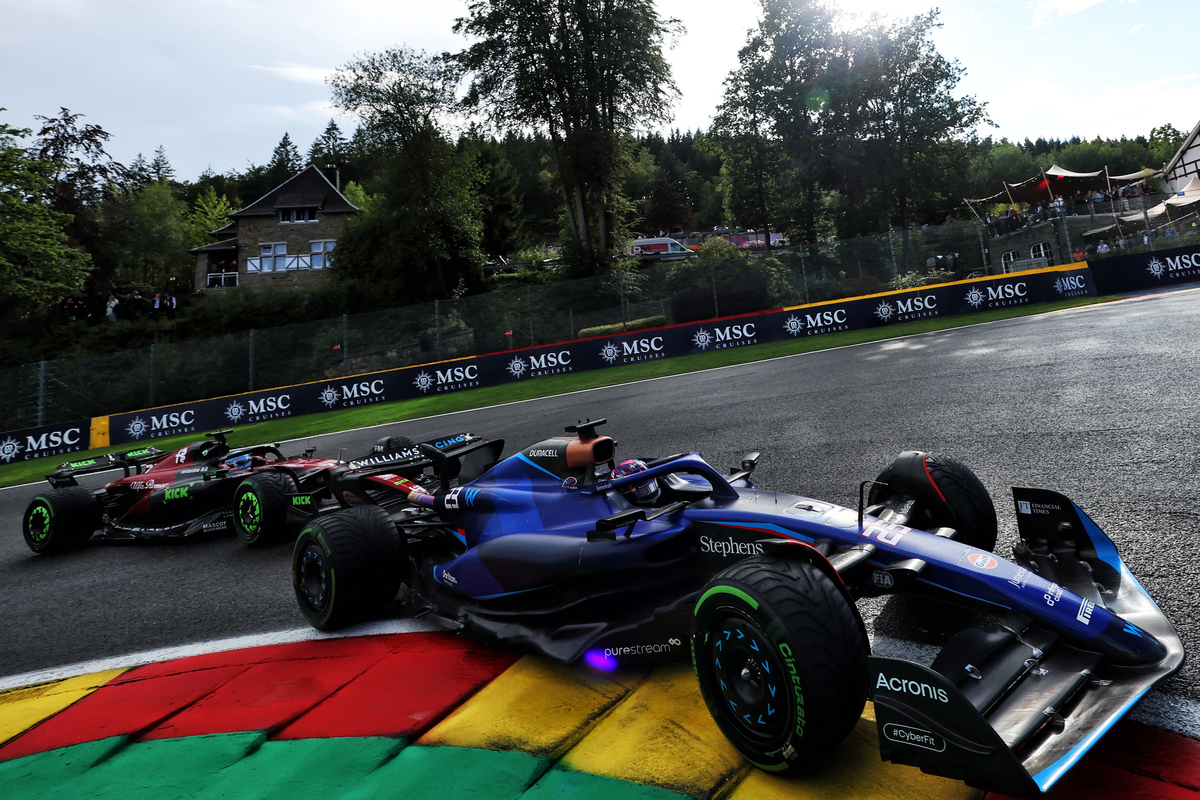
The financial landscape surrounding F1 is “still not” manageable, according to Williams boss James Vowles.
Vowles heads one of the smallest teams on the grid after joining from one of the largest, Mercedes, at the start of the season.
His task is to restore the operation to its former glory, a long-term endeavour by his own admission.
Helping that is a healthier financial position for the team as new rules have driven up the value of the sport and shored up the competitors.
“Formula 1 at the moment, if I compared to where it was 10 years ago if you look at 2008 2009, we had teams leaving in their droves,” Vowles told Speedcafe.
“There was an old adage which is the fastest way to become a millionaire is be a billionaire and own a Formula 1 team.
“What changed over the last [couple of years], the cost cap’s a very significant part of this.
“Now we have a business model that’s almost, almost manageable – it’s still not today.
“Williams… we put a lot of money in, in order to maintain this organisation.”
Financial rules limit teams to, in simple terms, USD $135 million a year to run the performance element of their Formula 1 operation (there are considerations over the number of races, and exceptions for certain staff, marketing, etc).
That provides a ceiling in terms of what teams can spend and has gone a long way to reducing the gulf between the front and rear of the grid, where once the difference would have easily exceeded the cost cap figure itself.
Add to that, changes to the way prize money is paid out and teams, even towards the back end of the field, can generate a sizeable portion of their annual budget purely from prize money.
Sponsorship then bridges that gap and on the whole, the sport is in a far more healthy position.
That’s evidenced by recent investments; a group including Ryan Reynolds purchased a 24 percent stake in Alpine for USD $200 million, which places its value at over USD $900 million.
Williams is owned by Dorilton Capital, which acquired it from the Williams family in August 2020 for USD $200 million.
According to valuations produced by Sportico in June, the team is now worth USD $795 million, a nearly 400 percent return on investment in two years.
“There’s two ways to value an organisation,” Vowles explained.
“There’s a way of valuing the organisation which is you take the revenues and nonprofit revenue, multiply it by a certain number – these are all standard elements of things.
“There’s another way which is you take the profit and multiply that by a certain number.
“Now, we don’t have profits, so if we were to use that, we would be a negative.
“But [if] you take the revenue, we would be a company that has a good amount of value.”
That value is only increasing as the sport continues to grow in appeal globally, transforming teams from loss-making enterprises into potential investment vehicles.
It’s precisely that which Dorilton has done, spotting the opportunity far earlier than most and in doing so reaping significant returns, even if that means topping up the budget every year.
Taking the Sportico valuation, it has netted USD $595 million in effective equity, if one only looks at the top level.
It can then afford to invest further to sustain the team, even to the tune of completely financing it (though in reality that is not the case at all).
In Dorilton’s three years of ownership, had it fully financed the operation it would have spent in the region of USD $420 million to operate at the cost cap.
With the business holding an estimated USD $595 million increase in value, that translates to a profit of USD $175 million, even in the worst-case scenario.
“What it’s sort of telling you is around 10 years ago, an organisation was valued around about $150 million, something like that for a good organisation, if it was profitable,” Vowles said.
“Now, you’re at a 10 times multiple of that, if not more in the case of Mercedes.
“But the problem with that is, that’s a moment in time and it could go down from there or up from there, it depends on where the business is.
“So actually, the real way of driving these businesses is to make sure that we’re not having to inject tens of millions each year in terms of money just to keep it going.
“What’s important for Dorilton is that we move to an environment where this is cash neutral, and then grows as the sport grows,” he added.
“I can achieve that, and that’s possible, and that’s what our intentions are to do.
“There’s two ways to do it,” he continued.
“You can do a Haas model where you spend not a lot of money, and they’re doing very well for the money.
“Or you can do it the way I intend to do it, which is to invest sensibly and start fighting towards the front.
“That journey leads to two things; one, it leads to more, if you look at our revenue sources, it leads to more FOM [Formula 1 Management] income – the further up, the more income you get, but it also leads to more sponsorship income, and that’s how you become breakeven or cost neutral.”
















Discussion about this post