


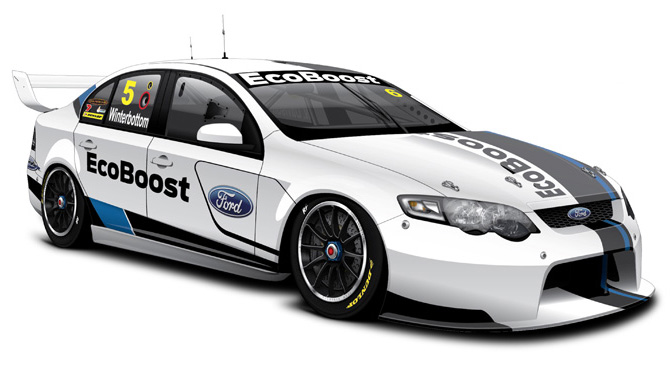
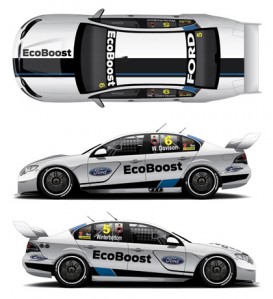
Ford Performance Racing’s first Car of the Future Falcon FG will wear Ford’s EcoBoost motorsport livery when it takes to the testing track in the coming months.
The car will display the white, black and blue factory look that Ford’s global motorsport teams have competed with this year.
Categories where similar liveries are used include NASCAR, World Rally and other touring car and rally competition.
The car, the third COTF chassis built by FPR, is expected to get its first track test next month.
Ford Australia motorsport boss Graham Barrie says having Ford’s factory team running the global EcoBoost livery highlights the importance of its V8 Supercars program.
“EcoBoost is the future of Ford’s engine technology globally so it makes sense that we use Car of the Future, the future of V8 Supercars, as our platform to promote it,” Barrie said.
“Ford Performance Racing’s first Falcon COTF will carry the same EcoBoost livery that all of Ford Racing’s official teams around the globe have run throughout the month of August.
“This further aligns our V8 Supercars program with Ford’s global motorsport plan and places it alongside the likes of NASCAR and the World Rally Championship.”
FPR team principal Tim Edwards says the livery is a timely link between Ford’s racing program and its road car technology.
“The impending debut of our first COTF Falcon coincides with an important time for Ford globally as the company rolls out more and more models featuring EcoBoost technology,” Edwards said.
“By running our test program in Ford’s EcoBoost motorsport colours, we are not only showcasing our team and category to the world, but also showing we are an important part of Ford’s racing program.
“It is also appropriate that we are running it on our Falcon at the same time road-going Falcons with EcoBoost engines are being produced just across the road from our workshop.”
EcoBoost is the name behind Ford’s engine technology, available in Australia in the locally-built Falcon, Mondeo and the soon to be released Focus ST. EcoBoost engines combine direct injection, turbocharging and variable valve timing and is said to improve performance and torque while improving fuel economy and reducing CO2 emissions.