


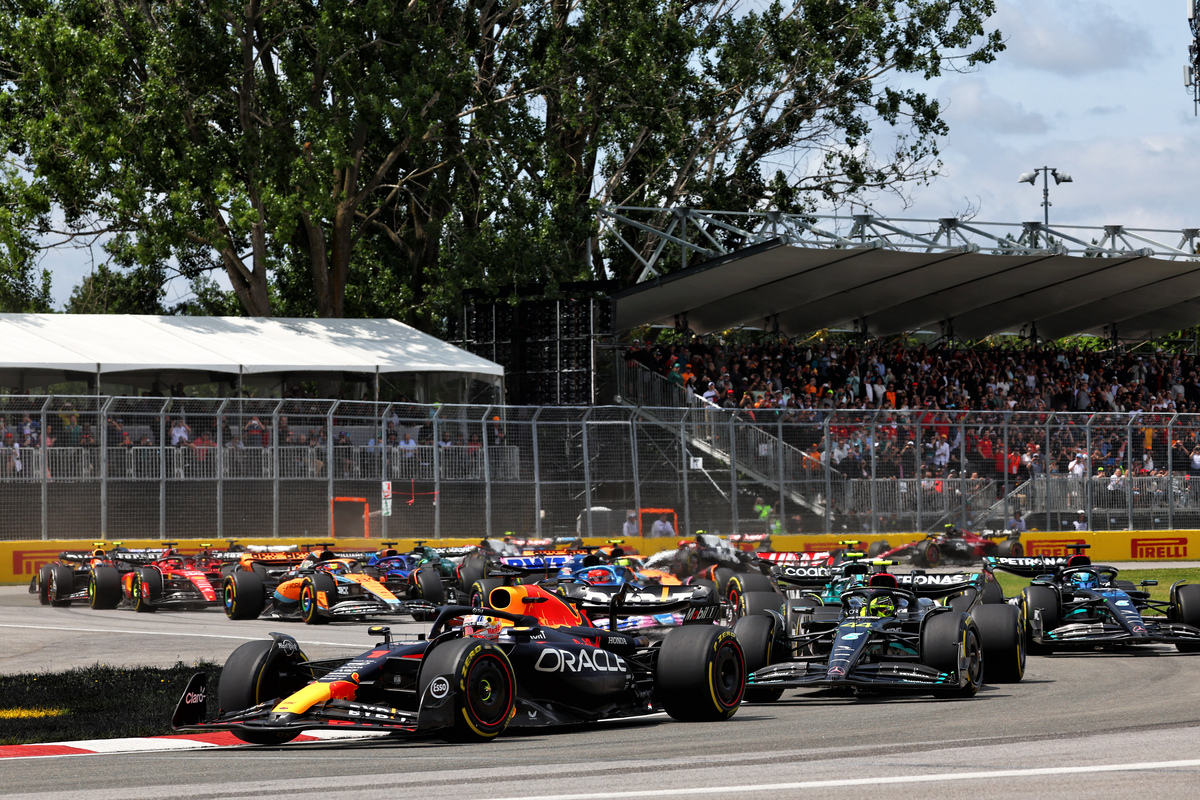
On the surface, the Canadian Grand Prix was another steamroller for Red Bull as Max Verstappen claimed yet another race win – the 41st of his career.
But, like has so often been the case this year, that simplifies a more nuanced race into a headline.
There was more to it than that and, in many respects, the race hung on a thread.
Verstappen hit a bird, the remnants of which were lodged in his brake duct for much of the race; what would have happened had Fernando Alonso been able to push the championship leader?
How much of Lewis Hamilton’s perceived pace was because Alonso was having to conserve fuel?
Even though that proved to be a false alarm, according to Aston Martin boss Mike Krack, it was a prudent move to ensure the Spaniard finished.
Alonso passed Hamilton on track on Lap 22 after dropping behind the Mercedes at the start.
The reason for the sluggish getaway for the Spaniard remains unclear, but that Hamilton was able to hold position is encouraging.
Mercedes struggled for tyre warmup throughout the weekend, so holding sway in the early laps suggests his car wasn’t overly disadvantaged versus the Aston Martin.
Sure, it was slower, but it wasn’t immediately vulnerable, and track position in Formula 1 is vital.
That was again evident after the Safety Car restart, as Alonso was not able to capitalise to claim the place from Hamilton – it took another 10 laps for that to happen, by which time temperatures and pressures had settled.
It was a genuine pass then, though perhaps once facilitated by differing wear profiles between the two cars; the Aston Martin is known to be kind to its tyres, while Mercedes is still understanding its heavily revised package.
Whatever the case, Hamilton put in a promising performance and kept Alonso honest.
Behind the podium places, there were other strong performances that warrant some explanation.
Ferrari climbed up the order, Alex Albon scored good points for Williams, and Valtteri Bottas made it inside the top 10, too.
All of those results have one thing in common; a gamble on pit strategy.
When George Russell clouted the wall on Lap 12 it effectively split the Canadian Grand Prix in two; those who stopped and those who didn’t.
Ahead of the race, Pirelli suggested the fastest strategy was a two-stopper, starting on a set of mediums and swapping onto the hards somewhere around Lap 15 to 22.
A second stop would then follow, bolting on another set of hards, somewhere between Lap 40 and 48.
Another option the tyre supplier suggested was to run deeper on the mediums, changing onto the hards between Laps 20 to 27 in what was a one-stopper – a slower strategy but a potentially viable one.
Russell’s crash fell a little earlier than was ideal for any of those and had arguably the greatest impact on those who started on the hards with a view to going long in the first stint.
That was the strategy Sergio Perez and Valtteri Bottas adopted, while Pierre Gasly began the race on softs.
The Frenchman pitted on Lap 10, dropping him down the order and not benefitting from the cheap stop the Russell Safety Car afforded – his race was effectively done from that point.
Pitting under the Safety Car was not a clear cut thing, and there were benefits for some by staying out.
The front three all pitted, as did Esteban Ocon who was fifth when Russell got the wall and fourth as he entered the lane.
Behind him, neither Ferrari stopped, electing to take track position over fresh rubber.
It was a bold call, and one that required Leclerc and Sainz to do one of two things from that point; hold position until the second round of stops, or extend a margin to those behind to safeguard the relative time loss if their pursuers opted for a single-stop.
At the time, there was no guarantee of a second stop, though odds favoured it based on Pirelli’s own strategy predictions. It was a gamble for Ferrari, but a calculated one.
The decision to remain out relied heavily on Leclerc and Sainz not destroying their tyres – either the hards they started on or the mediums they switched to with around 30 laps remaining (a longer stint than Pirelli suggested).
We can therefore view the call as a positive as it showed confidence in the car and its forecasted performance and a degree of assertiveness that has often been missing from the Ferrari pit wall.
Also opting not to stop was Kevin Magnussen, though that did not go as well for the Haas driver as the car once again ate its tyres and he drifted back quickly during the middle third of the race.
Having started on the mediums, Williams was compelled to pit Albon.
Had it not, he could realistically have only run another 10 or so laps on the set of tyres he had, and surrounded by rivals on fresh rubber he would not have had a pace advantage to extend a window to mitigate his stop.
In short; if he stopped he could minimise his losses later.
However, while most others stopped later in the race, Albon did not and he rose to seventh in the second pit stop cycle, having been 11th as it began.
While the Williams has its limitations, a strength is its straight-line speed. That helped Albon safeguard his position at the head of a train of cars that formed behind him in the closing laps.
Again, it was a brave strategy call; a risk from the team which had little to lose and could therefore afford to gamble more than its rivals.
It paid heavy dividends and was well executed by Albon in a drive that shows how a quality driver can excel in an underperforming car.
His performance was not completely dissimilar to that of Valtteri Bottas.
Alfa Romeo Sauber had started the Finn on the hard compound tyres and, like Williams, left him out under the early Safety Car.
Bottas gained strong track position as a result, running eighth through the middle part of the race before pitting on Lap 36.
That left a long, 34-lap run to the flag on the medium tyres, which in reality gave up the ghost well before the end of the race.
But Bottas hung on, despite battling graining on his left-front. His pace slowed in the latter laps, as one might expect. but he still claimed a world championship point.
Of course, he was fortunate; had Russell continued he’d have likely finished ahead of the Alfa Romeo Sauber, and Lando Norris’ penalty also worked in his favour.
Still, he was given an aggressive strategy to execute in a competitive midfield and he delivered – there’s no wonder he was pleased with the result post-race.
Elsewhere, McLaren’s Canadian Grand Prix performance was largely in line with expectations.
The cooler conditions meant Oscar Piastri and Norris were more competitive, though as the weather was both warmer and drier than qualifying, they fell back proportionally.
Upgrades are expected in Austria for the MCL60, the start of a three-race run of developments that effectively transform the car into the MCL60B.




























Discussion about this post