


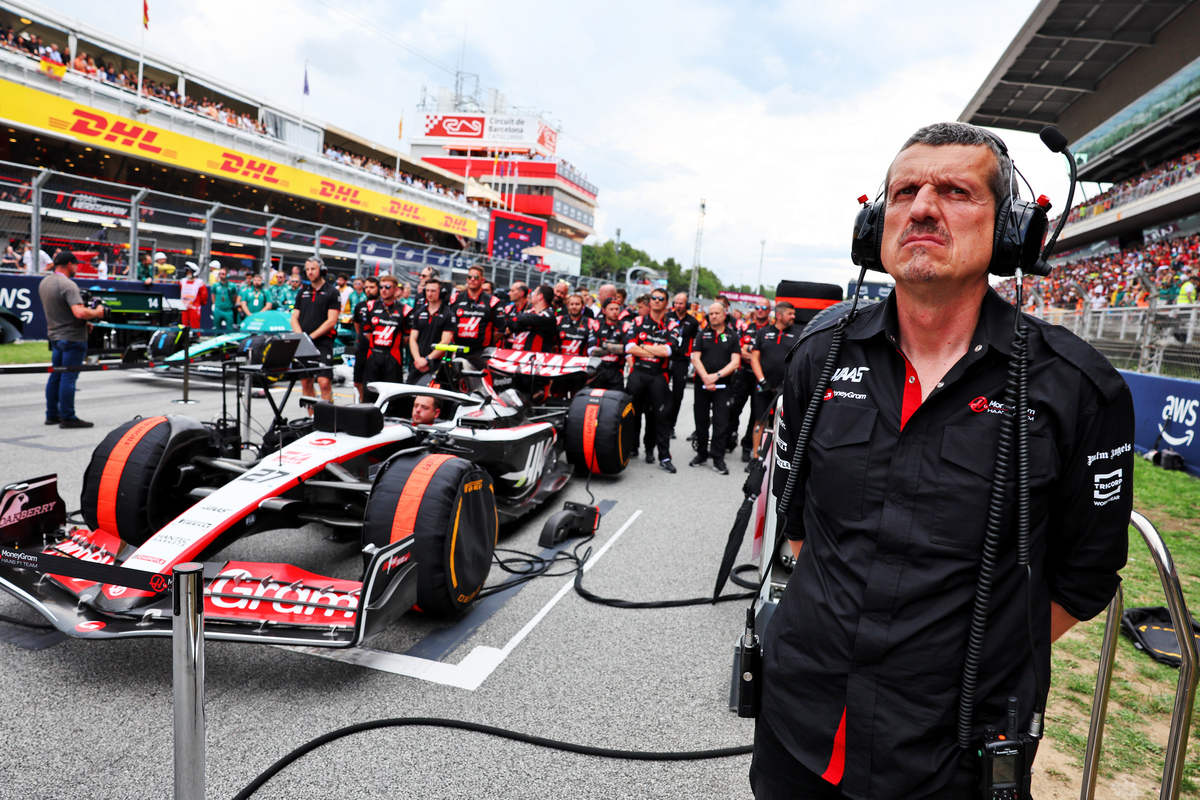
Simone Resta, technical director at Haas, has explained how the operation functions across three different facilities, in three different countries.
The American registered team has its formal headquarters in Charlotte, in the United States. From there, the administration of the team is managed.
In the United Kingdom, the race team is based out of a factory in Banbury, previously occupied by the Manor F1 team.
Resta, and the design staff, are based in Italy, working from an office in Maranello within the confines of Ferrari’s sprawling facility.
It creates a complex web, with the team spread across three timezones – and that’s before considering Dallara’s input into the team (it’s based in Parma, an hour or more from Maranello, in Italy).
“I suppose they make it quite harder in a way,” Resta conceded to Speedcafe.
The Italian has worked in F1 since the late 1990s, starting with Minardi before spells with Sauber and Ferrari.
He moved to Haas courtesy of the technical relationship that exists between the it and the Scuderia.
“Speaking about most of the teams, and if not all of the teams, but what they say is you’ve got like your facility, you’ve got the shop floor, you’ve got normally the car between races, they’ve got the mechanics, the designers can go there, speak together, discuss where you’ve got the production, you can see the components etcetra.
“And yeah, helps a lot to see the discussion more like, if you want, the informal discussion, and things normally they flow in a certain way.
“You can have a coffee with a mechanic and they can tell you how shit a certain part of the car is to mount, or stuff like that.”
That’s not possible for Haas. The design office in Maranello overlooks the Fiorano test track, while its race shop is in an industrial estate, about 20 miles west of Silverstone.
Without the ability to have those water cooler conversations, the team has had to find other ways of remaining connected.
The emergence of technology, especially systems that became prevalent through COVID, have played a crucial role in that.
“We are a massive user of Teams, like in COVID times, more or less I would say similar in a way, especially between facilities, say this facility [Maranello] and the wind tunnel group that is like a kilometre apart,” Resta explained.
“You end up doing meetings like that with Teams, with a lot of people.
“Phone, WhatsApp, or whatever; all this stuff that the younger generation are doing is our way of working.”
It’s an approach that contrasts many of the larger teams, who’ve worked to develop facilities to streamline communication and encourage casual conversations between staff and departments.
Haas’ approach may be different, but Resta sees the opportunities that presents, too.
“There’s a lot of diversity in the team, probably more than many other companies, because being spread in different countries with different nationalities etcetera, it’s a very diverse team,” he reasoned.
“So you join very different views of doing things, how to do things, which I think is quite positive.
“With regards to the peculiar set up that we’ve got, then clearly, the peculiarly thing that we are is, I will say, a smaller team on the grid.
“It’s quite lean. It’s a team that has learned how to operate in some point, to say across the COVID time, in difficult conditions and I think it’s quite a lean and efficient team where there isn’t much bureaucracy.
“There is not a huge command change that we need to do something, you need to involve so many people, it can be quite fast and efficient.”


























Discussion about this post