

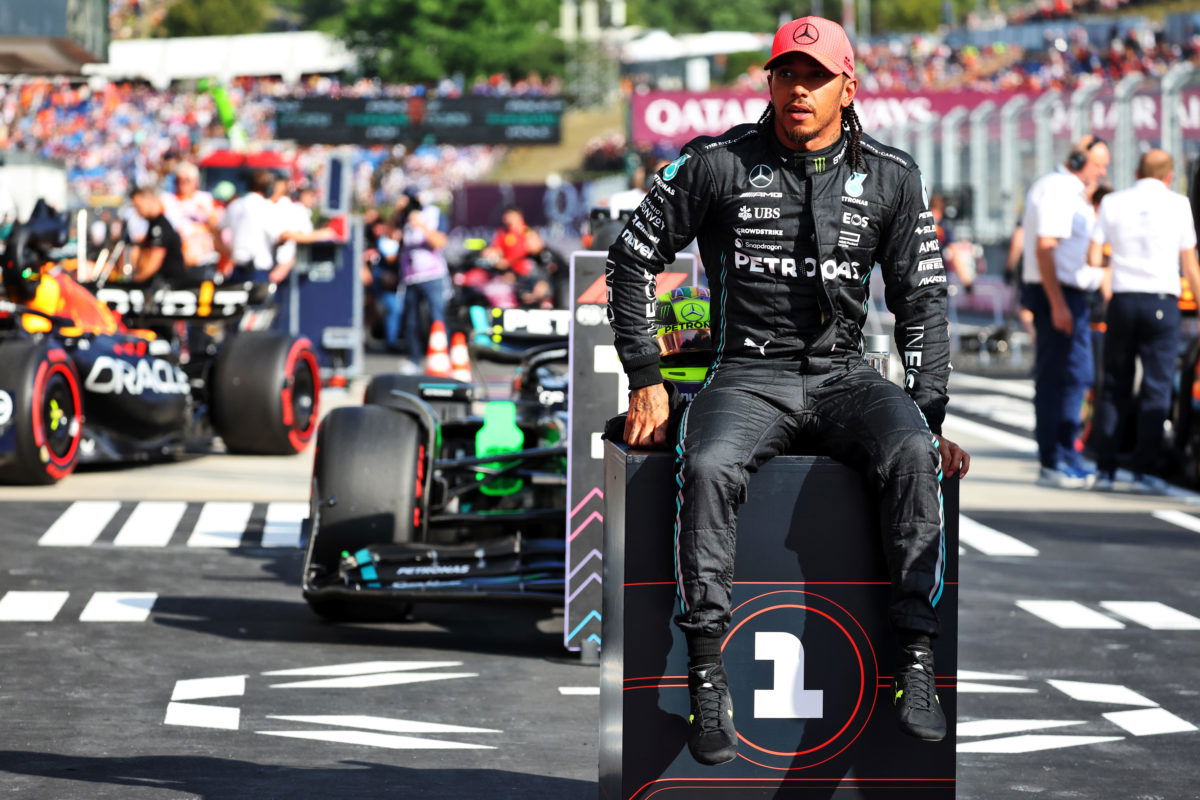

Mercedes team principal Toto Wolff was left to gloss over Lewis Hamilton’s first pole position for 34 races and reflect on the fact the W14 still has a fundamental weakness that is proving difficult to overcome.
For the first time since the 2021 Saudi Arabian Grand Prix, and for the 104th time in his F1 career, Hamilton will lead away the field after scoring a record-breaking pole at the Hungarian GP.
Hamilton is the first driver to claim nine poles at a single circuit, and whilst there was an understandable mix of joy and relief on the seven-time F1 champion’s part especially, the success has only masked the ongoing issues with the car.
“The biggest weakness in the car is not a lack of downforce, but that it is unpredictable,” said Wolff. “The drivers never have the confidence to really push it hard in qualifying.
“What they had with the car (in qualifying at the Hungaroring) was something that gave them confidence and allowed them to push without thinking that it could step out on the entry or exit of a corner.
“This is the main area we need to work out, giving them a car balance that is just more predictable.”
Despite a major upgrade package on the car that was delivered for the Monaco Grand Prix that cured some ills, the fact the W14 can work at some circuits and not at others is proving hard to understand for Mercedes, and for some of their rivals.
Alfa Romeo made their own leap forward on Saturday, with Zhou Guanyu qualifying a career-high fifth, whilst Valtteri Bottas starts two places further back.
Asked of Wolff whether track characteristics played a part or if the ongoing enigma of the ground-effect regulations were still paramount, he replied: “There’s certainly a part of these ground-effect cars being an enigma.
“Performances seem to come and go for all the teams – and congratulations to Alfa who are fifth and seventh on the grid, I don’t think they understand where that came from.
“Red Bull seems to be the only one to have really unlocked it and understand what happens, and maybe McLaren now.
“This is not something you can reverse engineer, this is something you have to work at and come to the right conclusions.”
Around a circuit lacking any major high-speed sections, Mercedes has also not had to figure out a compromise on set-up between the low- and high-speed, allowing the team to maintain focus on a specific area.
“I haven’t seen the overlays, but in the free practice sessions we weren’t particularly good in Turn 4 and Turn 11, and this is the high-speed part,” assessed Wolff. “This is also where we were lacking performance in Silverstone (the recent British Grand Prix).”
And with a nod to next weekend’s Belgian GP, he concluded: “Spa is obviously going to be a good benchmarking exercise because that’s what you need there, so another race, another set of data.”



























Discussion about this post