

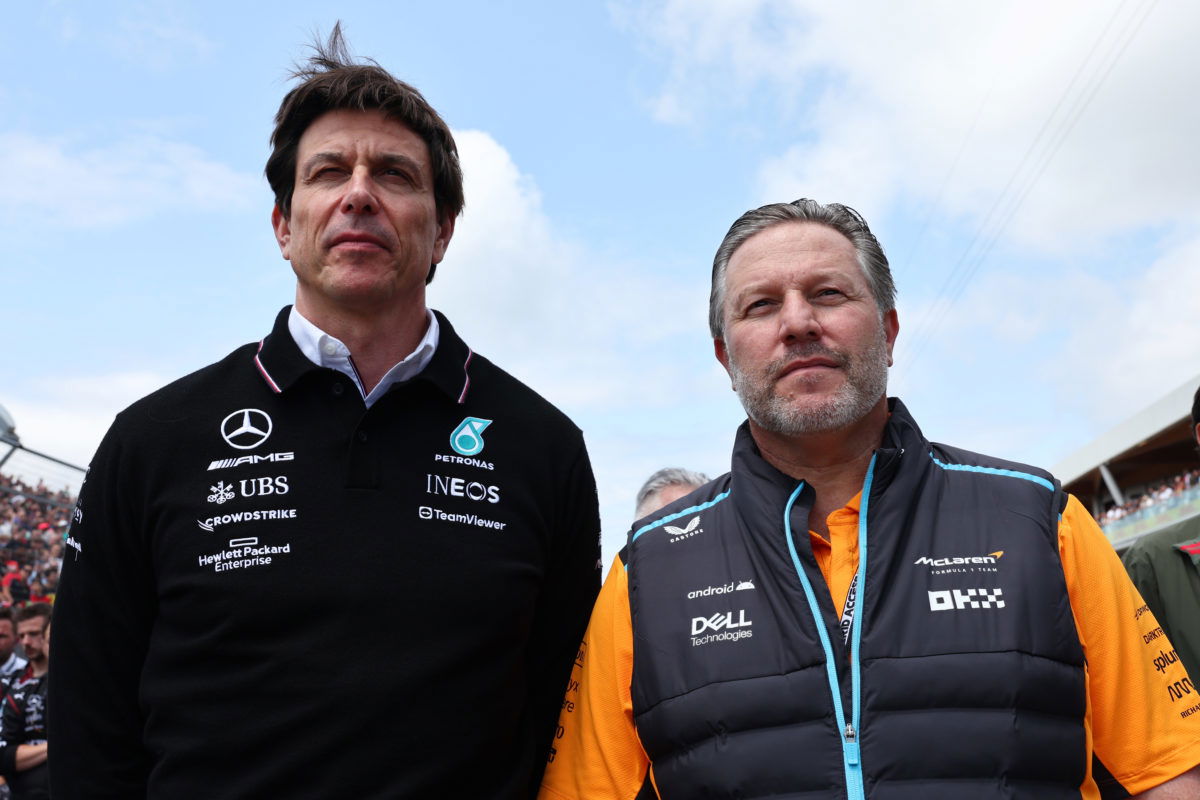

McLaren CEO Zak Brown and Williams team principal James Vowles are confident the 2026 version of F1 will not turn into another power unit-dominated championship.
The sport faces major change in less than three years’ time when new PU regulations are introduced that will see the cars powered by a combination of 50 percent combustion and 50 percent electrification, and run on sustainable fuels.
The decision has resulted in Audi joining F1 for the first time in the manufacturer’s history, Ford partnering with Red Bull as the team engages in the development of its own system, and the return of Honda in tandem with Aston Martin.
For the likes of McLaren and Williams, the two teams have a decision to make on whether to continue with Mercedes or join forces with another PU supplier.
At this stage, both Brown and Vowles have indicated it is unlikely they will ditch Mercedes, expressing confidence the German powerhouse will be at the forefront of the technology, as was the case in 2014 when the current 1.6-litre V6 turbo-hybrid systems were introduced.
They have also dismissed rising concerns the championship from 2026 will be based on engine performance.
“In any power unit regulation change you can win or you can lose out as a result of it,” said Vowles. “Mercedes did a very, very good job across the 2013/’14 changes.
“Probably if you go the years before then, again there were power unit suppliers that were slightly above but it did also settle out fairly quickly afterwards into a uniform formula.
“We have a great relationship with Mercedes and a long history behind it, and they’ve been strong in the sport for 20 years.
“My view on things is that whoever you go with, you will forge your alliance and it will settle down to a very sensible position very quickly shortly afterwards.
“It would be wrong to say the chassis still doesn’t have a large impact on it because, in the regulations, as raw as they are at the moment, there’s lots of potential to do better or worse than your competitors.”
Concurring with Vowles, Brown added: “We’ve a great partnership with Mercedes, so pretty hard to imagine them not getting it right, regardless of wherever the final rules shake out.
“And it’s always a combination, isn’t it, of driver, chassis and power unit to put out a competitive car, so I don’t think that’ll be any different, whether that’s with this regulation, the next regulation, or the regulation after that.”
Red Bull team principal Christian Horner, however, has indicated he would now like to see a tweak of the PU rules with a five-to-10 percent switch in favour of combustion over electrification within the PU.
Horner claims that if the change is not made, the as-yet-defined aerodynamic regulations will result in what he has described as ‘Frankenstein cars’ given the chassis that will be required to compensate for the change in power.
Mercedes team principal Toto Wolff has said there is “zero chance” of any changes being made now, with Brown insisting he is “ultimately not concerned”.
He added: “Everyone in Formula 1 is extremely smart and so whatever the final regulations are, they’ll figure it out.
“We have a great partner in Mercedes-Benz who have a fantastic history in the sport, so they do keep us in the loop.
“Obviously, we have an interest in making sure that the regulations are fit for purpose, and I have no doubt they will be, not just on the power unit but the chassis side as well, and there’s still work in progress.”
Agreeing with Brown on this occasion, Vowles remarked: “I think that summed it up well
“There is active discussion. This is being talked about continuously, and we’ll arrive at a solution.
“The direction of travel is quite clear – moving to sustainable fuels, moving to an engine formula that is prescribed. Now we just need to put a package around it that is good for the show.
“But the direction of movement is one where we’re working together.”





















Discussion about this post