

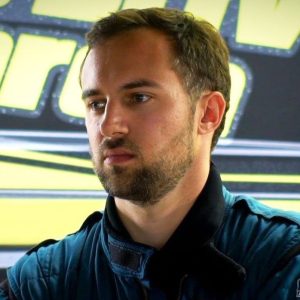

The right-foot braking technique that is commonplace in Supercars but foreign to the current breed of NASCAR regulars is the most obvious single differentiator between SVG and the field.
It first made headlines when van Gisbergen won on debut at the Chicago street course in 2023 aboard a Trackhouse Racing Chevrolet that had been fitted with a TV camera in its footwell.
Various NASCAR stars have tried adopting the technique since but are struggling to overcome years of muscle memory.
According to the TV broadcast, Team Penske’s Joey Logano began the Watkins Glen weekend right-foot braking but bailed out during practice.
Teammate Austin Cindric is also known to have attempted the switch and even ran a Supercars wildcard in Adelaide last year, in part to practice the craft.
Dale Earnhardt Jr put the spotlight on the situation this week via his popular Dale Jr Download podcast, featured below, outlining the perceived benefits.
Buy tickets
Manipulation of the clutch pedal theoretically allows SVG to both protect the rear tyres from the load placed on them by the drivetrain under brakes, as well as assisting turn-in.
Earnhardt Jr put the case directly to van Gisbergen, who all-but dismissed the advantage and claimed “people overthink it”.
“I don’t think it is a big advantage. Of course I’m going to say that, but it’s all I’ve known,” he said.
“I used to do it because you had to in a V8 Supercar.
“Because they would have a locked diff and you’d have to run so much rear brake to make it turn, you could control the rear lock in the brake zone.
“Then as you got to the brake zone, the clutch would be out as you turned in and it would help the car to turn.
“But in this [Next Gen Cup car], you don’t need to because the diff is open. So you don’t really have rear locking because you can run so much more front brake bias.”
Van Gisbergen’s data is able to be studied closely by rivals thanks to NASCAR’s open-book system called SMT.
Many appear convinced that use of the clutch is the key to SVG’s success, but knowing what he is doing and copying it are proving two different things.
“My feet are on the wrong pedals when I do it his way,” Trackhouse Racing teammate Ross Chastain said in the wake of Watkins Glen.
“I’ve learned my way and, at 33, it’s tough. I can do it intentionally for like a corner or three and then I get to the next corner, the next lap and I go back to my way.
“It’s just muscle memory.”
Right-foot braking was once commonplace at NASCAR road courses before the introduction of the modern generation of gearboxes.
NASCAR veteran Denny Hamlin noted this week that he was taught to road race with right-foot braking and was doing so when he won the Mexico City O’Reilly encounter 20 years ago.
After all these years, going back is not option for Hamlin. He also doubts whether younger drivers in the NASCAR system will take it up.
“It’s going to be really hard,” he said on Actions Detrimental. “I just don’t see anyone coming up the ranks that are volunteering to learn that style and stick with it.”
Trackhouse’s third driver, rookie Connor Zilisch, has emerged as SVG’s biggest and most consistent threat on road courses.
Hamlin said Zilisch, 19, is the best placed to rise to the challenge, indicating the youngster believes he can beat SVG even without the right-foot technique.
Zilisch, whose background includes karting and Trans Am racing, has beaten van Gisbergen in head-to-head battles in the O’Reilly Series but is yet do so in the Cup car.

He shadowed his teammate early in Sunday’s Cup race and later spoke of SVG’s advantage in a way that will sound familiar to the Kiwi’s former Supercars rivals.
However he does it, making speed while protecting his tyres is the key.
“You never see him slipping tyres,” said Zilisch.
“There’s times where, like out of Turn 6 into Turn 7, everybody else is getting to wide open [throttle] and he’s not even getting to wide open.
“Just little things like that where he doesn’t push the car beyond what it needs to be pushed.”
That canny driving, said Zilisch, means van Gisbergen can suddenly pick up the pace as a long run unfolds.
“Whenever people say he’s toying with people… it might not even be on purpose, but he just is able to save his stuff and maintain the lead,” he added.
“And then when he wants to go, he can go.”
Van Gisbergen’s first-up win on a rain-hit Chicago street course three years ago was dismissed by some as a one-off result from a perfect storm of circumstances.
But as he’s made the full-time transition to NASCAR, first through the Xfinity (now O’Reilly) Series in 2024 and then Cup from 2025, his road course form has only gotten stronger.
Van Gisbergen has now won six of the last seven road course races and rocketed to equal third on the all-time road course win list.
“I think it’s just being consistent with my people, working with the same guys all the time now,” he told Earnhardt of the continual improvement.
“The first years, I’d just turn up and race. And then even when I was with Kaulig in ’24, I’d just turn up and not have much influence in the setup.
“And last year, really, Mexico was really the first time we got outside our setup window of what we normally run and I kind of was able to guide the team a little bit.
“They listened and got the feeling I wanted from the car. It’s been awesome trying to develop the car and get it better.”
Two more road course races remain on this year’s NASCAR schedule – the new San Diego naval base race on June 21 and the annual visit to Sonoma the following weekend.






















Discussion about this post