


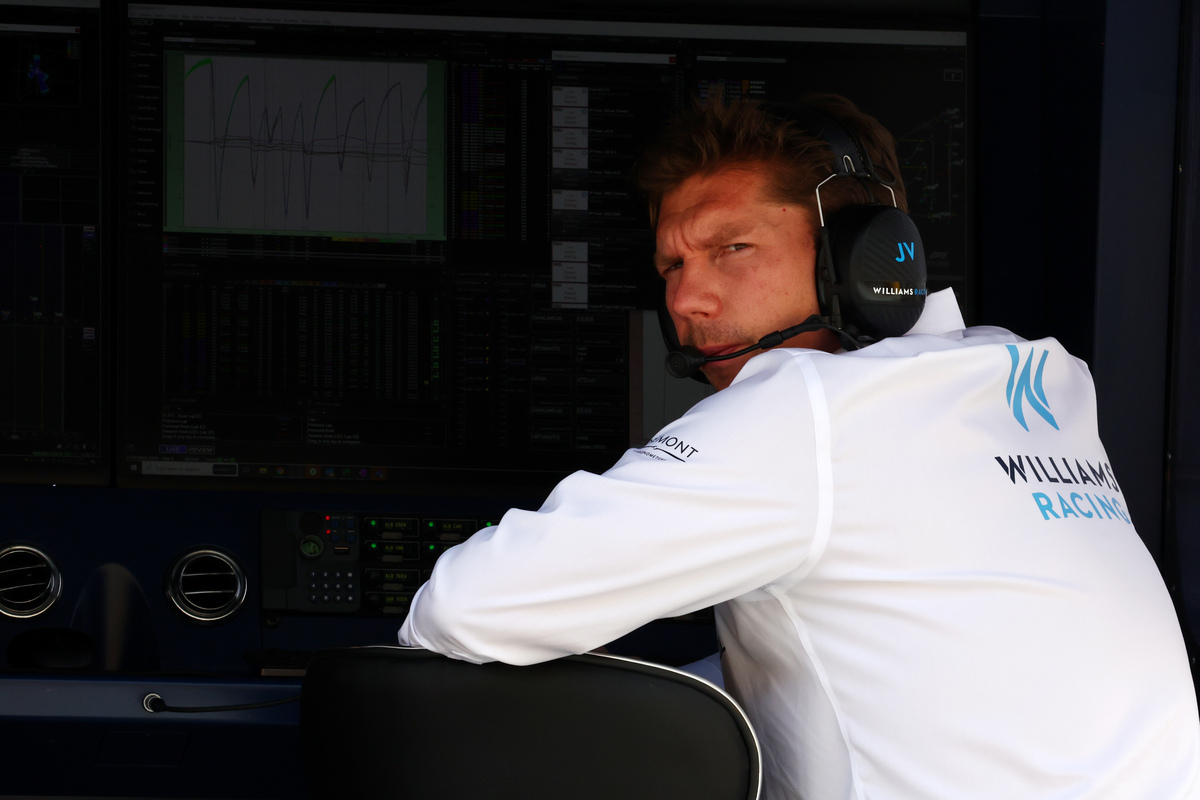
Williams boss James Vowles has explained why rebuilding the team is a long-term project, suggesting it will be three years before it begins to reap the fruits of his labour.
The British team, once a giant of the sport, has fallen down the order over recent decades. Its last win came courtesy of Pastor Maldonado at the 2012 Spanish Grand Prix.
Jacques Villeneuve remains its most recent world champion, after he beat Michael Schumacher to the title in 1997.
Vowles has made no secret of the team’s shortcomings since arriving in the job at the start of the year.
He cites a prolonged lack of investment as a key concern, highlighting fundamental areas the operation has fallen behind in.
Dorilton Capital, which purchased the business from the Williams family for USD $200 million in August 2020 has the capacity and appetite to invest, but that is not trivial.
Under F1’s current cost cap rules, both operational and capital expenditures are limited, meaning Vowles cannot simply commission new facilities on a whim.
Even if he could, the items needed are not short-term projects.
“So right now, for a lot of facilities that are missing, even if I have a spade and I broke ground tomorrow, it’d be 36 months before most of the big infrastructure is in place,” he explained.
“That’s different to a lot of other teams that already have that.
“And that’s not an abnormal period of time, the really quick stuff will be 24 months.
“That’s just getting the infrastructure in place,” he added.
“That’s not changing behaviours, culture, systems, integrating proper ERP [enterprise resource planning] into our entire world, that’s just buildings and infrastructure that’s not there.
“Your bare minimum you’re looking at is getting the infrastructure in place, plus a period of time of learning with it, and trying to catch up to your rivals that have been using it for 15 years.
“So, when we talk about five years, there’s good reason behind it.”
Five years is an aggressive target – somewhere akin to Alpine’s 100 race plan.
There is currently no pathway within the regulations for Williams to build a new wind tunnel or make other key investments needed to bring it up to par with rivals, a point that will only delay its recovery.
On top of that is recruiting the right staff and, to do that, consistent improvement off-track will be critical.
The appointment of Pat Fry as the team’s technical boss is a good start to the Williams rebuild, as is Vowles himself.
“It depends on where you are, what journey you have to do in front of you, what infrastructure you have to put in place, culture, which I’m really strong on, but culture doesn’t appear overnight,” Vowles said.
“In my experience, for about 100 people, it’s three years to change a culture within an organisation.
“That’s a made-up number by me but I’ve been through this enough times in the sport to see it.
“So both of those will start delivering, I think, good amounts of performance in three years.
“That’s not championship winning because, at the moment, we don’t have the money to spend up to the championship winners.
“As much as it’s valuable, the cost cap is hindering us, and we are certainly behind them on leading edge.
“What we also need is the sport to realise that, on any given Sunday, anyone should have the ability to win.
“We started to migrate towards that; ATR [aerodynamic testing restrictions] is a little bit of a step towards it.
“But the sport will, I think, go through another change itself over the next three to five years, which will, to a certain extent from that timeline as well.
“I think five years is not a bad period of time to be talking about.”



















Discussion about this post