

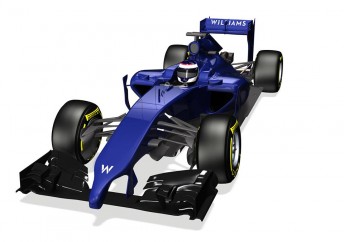
An image of its FW36 released by Williams has revealed the distinctive nose design solution expected to be seen on much of the 2014 field.
This year’s regulations require a lower nose tip than previous years in the name of safety.
The team’s desire for a high nose in order to maximise under car airflow has resulted in the heavily tapered tip.
Although much pre-season talk has surrounded engines and mechanical reliability, Williams chief technical officers Pat Symonds warns that aerodynamics are still the single most important performance factor.
“F1 is still going to be an aerodynamic formula in 2014,” he said.
“There are some significant changes: the nose is lower than last year and the front wing is narrower, which means the end plates are now more shrouded by the front tyre.
“The rear wing isn’t as deep as last year and the beam wing below it is no longer permitted, and we’ve also lost the ability to use the exhaust to enhance aero performance.”
The FW36 is Williams’ first car since switching from Renault to Mercedes engines, coinciding with the formula change to 1.6 litre turbos.
“There’s a lot more technology on the cars this year,” said Symonds.
“We’ve had turbo-charged engines in F1 before; what’s different this time is that it is much more than just an engine change, it is a completely different system.
We’ve gone from a slightly hybridised normally aspirated engine to a fully integrated hybrid power unit with novel technology at its heart.
“Overall the cars will need more cooling this year,” he added.
“The demands on water and oil cooling may be slightly diminished, but the ERS system is significantly more powerful and hence needs more cooling.
“We also have to cool the charge air from the turbocharger compressor which requires a substantial intercooler.”
Williams has produced its own eight-speed gearbox for the car, rather than adopting the Mercedes unit.
The FW36 will be seen in public for the first time at next week’s opening pre-season test in Jerez, Spain.