


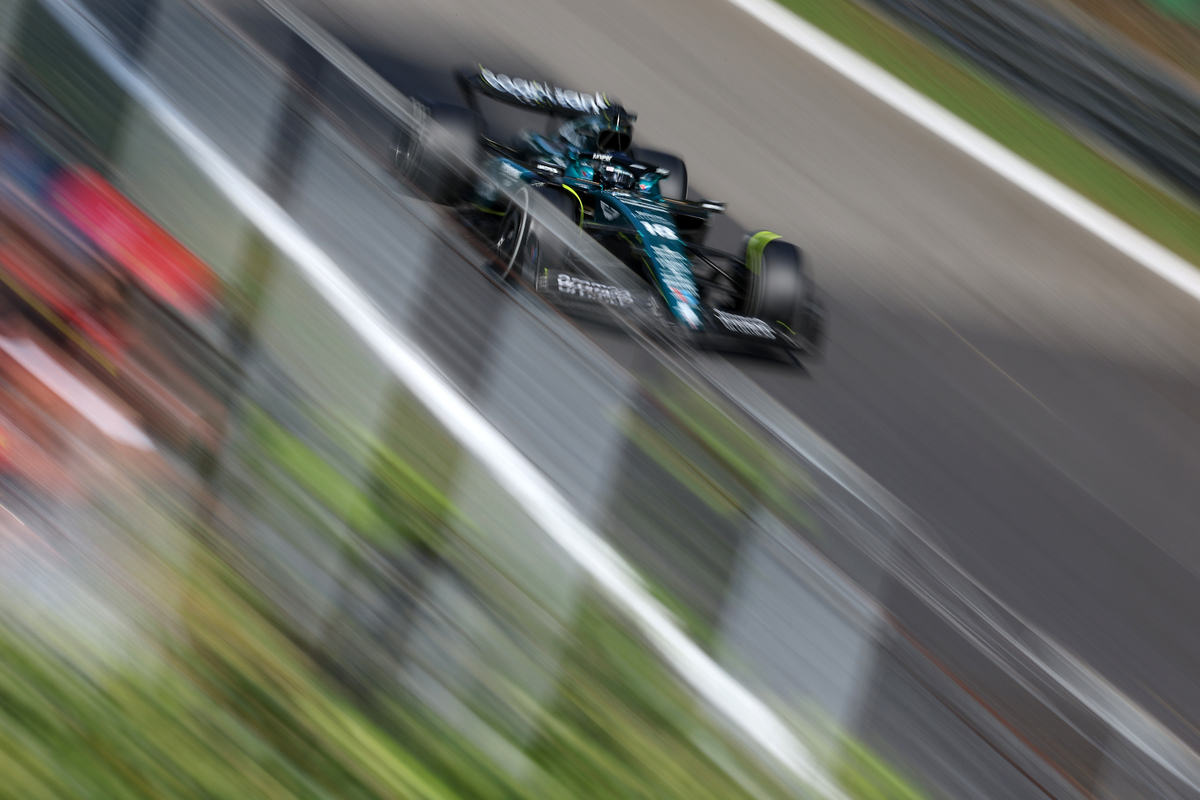
Aston Martin has already shifted focus from its 2023 challenger to the design of its 2024 F1 car with a particular focus on improving aerodynamic efficiency.
The British squad has been a standout performer this season, scoring podiums at six of the opening eight races of the year.
That leaves the team fourth in the constructors’ championship after it finished seventh in the competition in 2022.
Looking to use the current campaign as a springboard for more the team has identified areas of improvement for the AMR24.
That includes its straight-line performance, a known weakness according to performance director, Tom McCullough.
“Fernando [Alonso] touched on the efficiency of the car,” he said.
“It’s an area where, at the start of the year, we were definitely one of the slower cars in a straight line.
“We worked on that with the base car and also the rear wing levels that we brought [to Monza].
“It is an area of improvement, it’s an area we need to do more for next year.”
In qualifying for the Italian Grand Prix, Alonso was only 11th fastest in terms of maximum top speed at 346.5 km/h, more than 5 km/h down on the Ferrari-powered Haas of Kevin Magnussen.
The Spaniard was also 2.5 km/h slower than Alex Albon, whose Williams is powered by the same Mercedes engine as the Aston Martin.
Curiously, both factory Mercedes sat at the foot of that table, Lewis Hamilton topping out a 340.6 km/h and George Russell at 338.6 km/h.
Max Verstappen, who went on to win the race, had a qualifying top speed of 344 km/h, while Carlos Sainz took pole with a v-max of 350.8 km/h.
It suggests that while top speed may be an area of concern for Aston Martin, it is not the sole explanation for its performance in Monza, which saw Alonso ninth and Lance Stroll 18th.
Part of that was a result of Aston Martin being unable to get the most out of the soft compound tyres but also suggests that, around the Italian GP venue, top speed no longer directly correlates to lap time.
“To be fast in the highspeed, grip limited corners is really important because nearly all of them, the second Lesmo, Ascari, the Parabolica, have got very long straights after them,” McCullough said of the compromise it forces teams to make.
“So you’re always trading speed through those corners versus your raceabilty and straight-line speed.
“I think these generation of cars and characteristics of people’s cars has led to a bit of a difference in rear wing philosophy but it’s largely as we expected.”
Despite that, it’s an area Aston Martin is looking at as it develops next year’s car, the AMR24.
“With the car we’ve got now, the main architecture of the car, the whole more than just the rear wings are the areas that we work on,” McCullough explained.
“A lot of elements actually influence the aero efficiency of the car and from now to the end of the season, most of the tracks are not the higher efficiency tracks.
“Our focus is really on AMR24 to make sure that, as we’re developing that care, we’re developing it as efficiently as we can do, and more efficient really than this year’s car.”




















Discussion about this post