

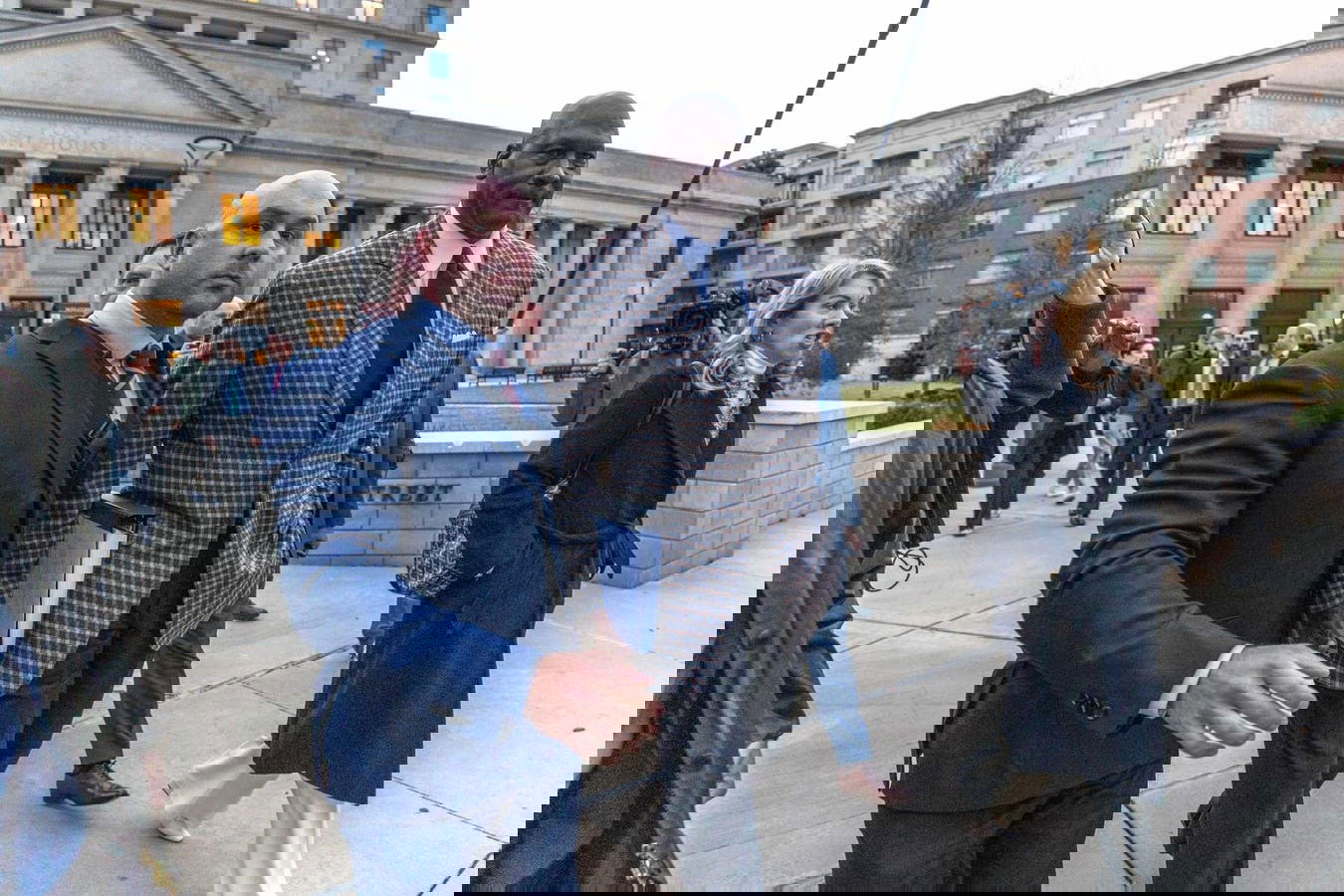
The NASCAR antitrust trial resumed Tuesday with a packed day of testimony and increasingly pointed warnings from Judge Louis B. Bell as the case entered a more contentious phase.
Front Row Motorsports owner Bob Jenkins completed his testimony in the morning before the spotlight shifted to NASCAR president Steve O’Donnell, who spent much of the day under prolonged questioning from plaintiffs’ attorney Jeffrey Kessler.
Jenkins’ appearance concluded with a tense back-and-forth over the finances of Front Row Motorsports and the broader economics of Cup teams.
NASCAR attorney Lawrence Buterman attempted to portray Jenkins as someone who used his outside businesses to distort FRM’s financial condition, but many of those questions were cut off on objections.
Jenkins reiterated his often-stated view that a competitive Cup entry requires an investment of roughly $20 million per car—though FRM’s own records reportedly never showed more than $14.5 million during the damages period.
He insisted the $20 million figure represented an aggregate based on data supplied across multiple teams, adding their financial expert will address the calculation later in the trial.
Buterman also questioned why FRM’s damages request included more than $1 million associated with Truck Series losses.
Jenkins conceded such losses should not be part of Cup-related damage claims.
The NASCAR attorney then pressed him about why he kept purchasing charters if he believed the underlying agreements were unfair.
Jenkins answered bluntly: he bought them “based on the belief that some day, they will be fair.”
Texts between Jenkins and 23XI Racing co-owner Denny Hamlin surfaced again.
Buterman argued that Jenkins’ self-imposed deadline during the attempted FRM-23XI merger was no different than NASCAR’s own charter deadlines.
Jenkins rejected the comparison, saying he wasn’t a monopoly and Hamlin had alternatives, including StarCom or Rick Ware Racing.
He also pushed back on the implication he influenced charter pricing, even after a text showed him telling FRM president Jerry Freeze that Rick Ware could “charge whatever” to Hamlin.
Jenkins insisted he wasn’t imposing anything on RWR and did not share sensitive financial information.
Ultimately, the merger collapsed because Toyota could not support two engine programs for the deal, and Jenkins needed clarity because Ford and Roush wanted to know his long-term direction.
After the lunch recess, O’Donnell took the stand and remained there for hours as Kessler launched into a wide-ranging examination covering NASCAR internal tensions, charter negotiations, and concerns over potential competitor series.
Much of the questioning revolved around O’Donnell’s handwritten notes, internal messages, and past discussions about everything from “Gold Codes”—a term Kessler later said he had to Google, describing it as a “nuclear option”—to breakaway series planning.
Kessler pressed O’Donnell on whether he prepared for the possibility that Cup teams could form a rival league.
O’Donnell acknowledged he considered scenarios involving Speedway Motorsports tracks, Eldora, and Indianapolis Motor Speedway, adding that planning for adverse conditions is part of his job.
That line of questioning connected to NASCAR’s recent practice of adding exclusivity clauses to Xfinity and Truck Series sanctioning agreements.
Kessler argued such clauses leave virtually no viable venues for a startup series.
In one of several testy moments, O’Donnell maintained that teams unwilling to sign the charter agreements could still attempt to race as open entries.
Kessler dismissed that as unrealistic, prompting O’Donnell to answer, “I’m not sure about that.”
The plaintiffs also tied O’Donnell’s past communications to broader frustrations within NASCAR leadership.
Notes from a meeting showed Jeff Gordon asking whether the France family “was open to a new model” for 2025—Ben Kennedy answered yes at the time. When asked whether Jim France ultimately supported a new model, O’Donnell responded that he did not.
Another message, in which O’Donnell referenced Kennedy’s negotiation stance as a “comfortable 1996, fuck the teams, dictatorship…tiny sport,” became a flashpoint.
O’Donnell hesitated for an extended moment before saying the “dictator” remark “could be anyone.”
A significant piece of Kessler’s case involved NASCAR’s internal response to SRX.
O’Donnell admitted he grew increasingly concerned about SRX in its second and third seasons as active Cup drivers joined and the series began to “look more and more like NASCAR.”
He testified he initially believed Tony Stewart’s involvement—given Stewart’s position as an SHR charter holder—could blur competitive lines.
He said SHR president Brett Frood initially assured him SRX would not resemble a NASCAR product, but “all things that ended up happening.”
Kessler highlighted NASCAR’s refusal to grant Speedway Motorsports an exception to host SRX events, arguing that NASCAR used contract terms to limit competitors.
O’Donnell said that was during broadcast negotiations, and “we wanted to gain as much TV revenue for the teams and tracks as possible.”
When asked whether he sought legal review on Hamlin’s SRX participation because he wanted to stop SRX altogether, O’Donnell replied, “I just wanted legal to look at it.”
O’Donnell’s testimony also touched on NASCAR’s high-risk business decisions.
He said he earns a $1.2 million salary plus bonuses and noted that NASCAR lost $6 million on the Mexico City race and $55 million over three years at the Chicago Street Course.
Despite those losses, he claimed the Chicago event was pivotal, saying NASCAR “was able to get $1 billion because we had the Chicago Street Race and Mexico City,” and that Amazon would not have signed without Chicago.
The removal of the “three strikes” rule—an older governance mechanism allowing teams to veto decisions—also surfaced.
O’Donnell testified that teams were using it to block growth initiatives and that “we wouldn’t have gone to the Chicago Street Race or Mexico City” if it remained.
By late afternoon, Judge Bell’s frustration grew evident.
He told both legal teams the trial was not progressing quickly enough and warned that the jury was encountering “a whole lot of trees and not a lot of forest,” with repetitive exhibits and redundant questioning.
Bell said the plaintiffs’ plan to finish by Wednesday must accelerate.
Kessler admitted the earliest he would conclude was next Tuesday, which the judge did not accept.
Both sides said they have begun cutting witnesses to meet the court’s expected timeline. Bell also emphasized that Roger Penske must testify whenever required, given his limited availability.
As the day ended, O’Donnell’s direct questioning shifted to NASCAR counsel Christopher Yates for the final hour. But the judge’s tone made clear the pace must change.
With weeks of testimony still ahead, the trial remains locked in a slow-grinding battle between granular details and sweeping allegations, and both sides are under increasing pressure to bring clarity before the jury loses patience.
















Discussion about this post