
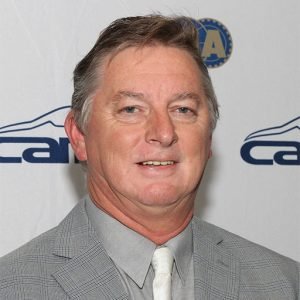

Brent Edwards had a short career in Club Cars (now Improved Production) in the early 1990s before he moved to 2.0-litre Sports Sedans with his Datsun 1600 for a couple of seasons.
Then followed a sabbatical that continued to 2010 where other matters took precedence, such as building a house.
Brent was drawn back to the sport through club sprints before he returned to full racing in a Production Car Ford FPV F6, in his home state of Victoria. It wasn’t until 2014 that he became involved in a national series, in Saloon Cars.
“I wanted to run in the Sportsman Class (for the older cars) in an EA Falcon, but it blew up on the dyno before the first race,” Brent recalled.
“I met Les Morrall who was running the category, and he was able to provide an AU.”
Brent finished the first season 14th, and the second year fourth. In the 2017 Victorian Saloon Car Championship he was third overall, initially in the AU and then a new BA which scored pole at Winton.
At the end of the 2017 however, the BA was “written out of the rule book”. Brent was basically left to race his car in the Super 6/Group 4 category which didn’t last long. Then there was Thunder Sports and still activity in Production Cars, aboard a BMW 130i.
He also had success at the Bathurst 6 Hour in 2023, sharing a Holden Commodore SSV for a Class B2 victory, also ahead of all the B1 entries and 16th outright.
When Thunder Sports petered, he competed in NSW Super TT along with a couple of others who had built BAs and Brent had turbocharged his car to be competitive, albeit with some reliability issues for a while.
“Super TT really came on when Stephen Whyte proposed to run a national series,” Brent said.
Cars have to be developed from road registered vehicles with factory firewall, but not of tube chassis construction. Modifications allowed include wheel wells and floorplan with strengthening of the jacking points.
All panels can be changed to fibreglass or carbon composite, and factory glass can be changed for Lexan or polycarbonate. Rear wings of a maximum 1830mm width (including endplates) are permitted and can be no higher than the roof. Front splitters are permitted but can’t be 150mm past furthest front part of car and diffusers can go back to parallel with front axle line.
Front suspension is free but must retain original configuration. Rear suspension can be replaced with a live or dead beam axle. Wheels and tyres are free, with some restrictions. Engines up to 7.0-litres in swept volume are free in two-wheel-drive while all-wheel drives must retain original cylinder blocks and heads.
“Super TT is most affordable for people to do; it is a great step from sprints and time attack. There are lots of freedoms without breaking the bank.
“It’s a grassroots class that runs at national level with brilliant free-to-air television coverage,” Brent added.



























Discussion about this post