
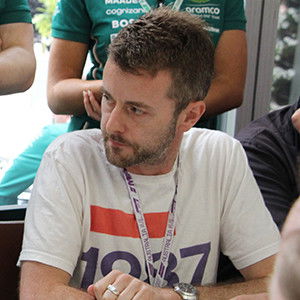

Speaking to Speedcafe, Daly said he was concerned the heavier reliance on battery management and energy deployment had fundamentally changed the nature of F1 driving.
The 73-year-old, who competed in 49 grands prix between 1978 and 1982 for teams including Williams, Tyrrell and March, admitted he remained “old school” in his view of what F1 drivers should be rewarded for behind the wheel.
“One of the greatest joys for me was to see Ricciardo outbreak somebody from half a mile behind because he had that gift,” Daly said.
“Ricciardo might not make it in Formula 1 today because they’ve taken away the element of a racing driver that he was.”
The 2026 regulations introduced sweeping technical changes focused around increased electrical deployment, active aerodynamics and energy harvesting, creating a style of racing that has divided opinion throughout the opening rounds of the season.
Drivers have frequently been forced into lift-and-coast techniques and battery management battles, producing what many have described as ‘yo-yo’ racing as rivals repeatedly exchange positions down straights.
Verstappen has emerged as one of the most vocal critics of the new era, previously describing the racing as “playing Mario Kart” and claiming “this is not racing.”
Daly said he agreed with the concerns being raised by the four-time world champion, particularly around the way the new cars had altered driver technique.
“I saw Peter Windsor do an amazing piece about they’ve neutralised Verstappen and [Charles] Leclerc’s high speed turning ability with the car that’s loose and on the edge of taking that away,” Daly explained.
“So I hate that. I want them to bring that back.”
While Daly said he supported F1’s move towards greater electrical power, he questioned the way the current regulations generated and deployed energy.
“I’m okay with electrical power, but I’m not okay with how they generate it at the moment,” he said.
The FIA has already moved to revise elements of the regulations after widespread criticism during the opening races of the season, introducing mid-season changes before the Miami Grand Prix aimed at reducing excessive energy harvesting and improving safety.
Further changes have already been approved in principle for 2027, including reducing battery deployment and increasing internal combustion engine output following complaints from drivers and teams.
Despite acknowledging Miami produced entertaining racing on the surface, Daly admitted the style of overtaking left him uncomfortable.
“The last race in Miami was amazing to watch if you didn’t know how the passes were happening,” he said.
“But when I see a driver back off on the straight before he gets to the brake zone, I cringe.
“I understand what they’re trying to do, but I’m old school, and I still cringe.”
Daly also questioned whether the current regulations risked favouring drivers with simulator and gaming-style skillsets over instinctive racers capable of operating cars on the limit.
“Are we by default eliminating supremely talented drivers like Verstappen or Daniel Ricciardo or Leclerc in the future?” Daly said.
“Are we opening Formula 1 up to gamers who understand how to how to technically get speed from an object? I’m not saying a racing car, an object.
“Because they’re gamers and they’re brought up in the video gaming world. I don’t know.
“I’d hate to think that.”



















Discussion about this post